
Search Charlotte County Property Records in a Clear Order
Charlotte County keeps its property records in separate offices. Each custodian answers a different question. Start with whatever identifier you hold. Have a street address? The Commissioner of the Revenue's current property-card site is the natural first stop. A tax notice may show an account, record, or map number instead. That exact label works better than a guess. Remember that the card is only an administrative assessment record. The deed, the tax bill, and the map each tell a different story.
For an ownership question, copy the owner's displayed name and the legal description from the card. Then search for the latest deed in Virginia's Secure Remote Access system. Charlotte Circuit Court participates there. The Treasurer's portal covers balances and payment status. The county-linked GIS map adds parcel context. Treat any result as a lead toward the official record. It is not a title opinion or a survey.
- Search the current card site by address, owner name, location, map, account, or record.
- Save the card's identifiers and legal description; the reassessment card is a separate 2025 dataset.
- Check the recorded deed and related instruments through the Circuit Clerk or SRA.
- Use GIS to orient the parcel, then use the Treasurer for bill status and payment.
- Ask the office that holds a missing file for a counter, mail, or FOIA route.
Where Charlotte County Property Records Are Kept
Charlotte County property records are split by record type. Recorded land instruments belong to the Circuit Court Clerk. The Commissioner of the Revenue maintains assessment cards and tax maps, while the Treasurer holds tax bills and payment information. No single office replaces another. Call the custodian before you travel whenever you need a historic book, a certified copy, or a record that is not online.
Charlotte Circuit Court Clerk
115 David Bruce Avenue, P.O. Box 38
Charlotte Court House, VA 23923
(434) 542-5147
Commissioner of the Revenue
205 David Bruce Avenue, P.O. Box 308
Charlotte Court House, VA 23923
(434) 542-5546
Charlotte County Treasurer
201 David Bruce Avenue, P.O. Box 267
Charlotte Court House, VA 23923
(434) 542-5125
Two Card Portals Serve Charlotte County Property Records
Charlotte County links two card portals. One is a current property-card search, and the other is a separate 2025 reassessment-card search. Both support Record, Account, Map, Name, Location, and Address modes. On the reassessment site, Instrument Number and Subdivision appear when available. A full owner name can return nothing; the county portal suggests trying the surname alone. Rural addresses sometimes use route-style wording. A road name or a map number from a tax notice may work better.
Pick the current card for the county's present property-card view. Pick the reassessment portal for the values set in the 2025 cycle. Note which portal produced a value or owner name, since the two are distinct datasets. The landing pages do not expose every result field. Confirm a displayed owner, sale detail, or legal description against the underlying custodian record before relying on it. The county's current property-card search presents its search modes on the entry page. That page shows the query options rather than an individual parcel result.
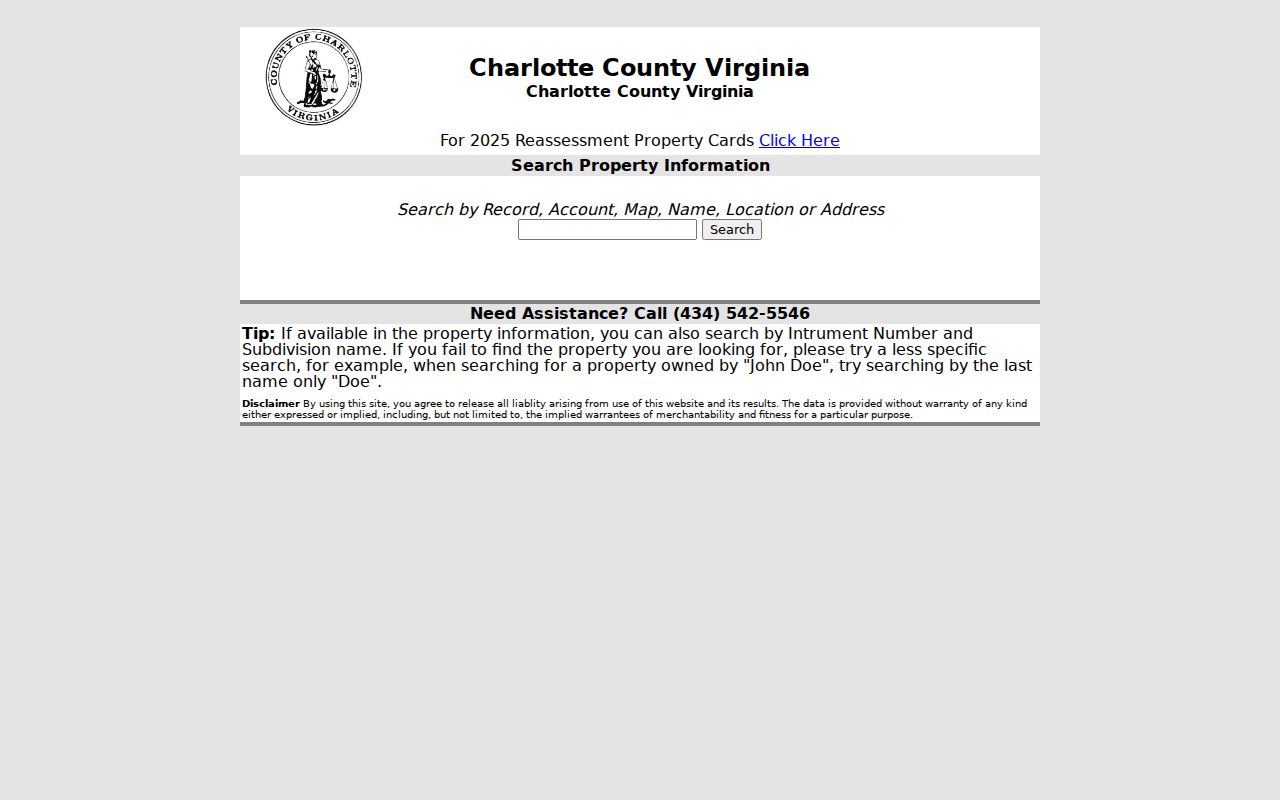
Keep your chosen mode and identifier in your notes. That way a repeat search will not confuse a map number with an account or instrument number.
The 2025 Reassessment Changed Charlotte County Property Records
Charlotte County's latest general reassessment took effect July 1, 2025. The prior effective date was July 1, 2019. Reassessments run on a six-year cycle. Pearson's Appraisal Services completed this one. Notices went out by mail. The county posts online reassessment cards, so anyone can review the 2025 values.
The county notice gave category ranges for typical increases. Site-built and modular homes generally rose 50% to 65%. Doublewides rose up to 70%. Land rose 30% to 50%. Commercial or industrial property rose 10% to 20%. Those ranges describe categories, not any specific parcel. The county also cut the real-estate rate from $0.62 to $0.41 per $100 of assessed value. It aims to collect no more than 1% more real-estate revenue than the prior year. Use the 2025 reassessment property-card search when reviewing that valuation cycle. The portal's entry page displays its search modes, along with its less-specific name-search tip.
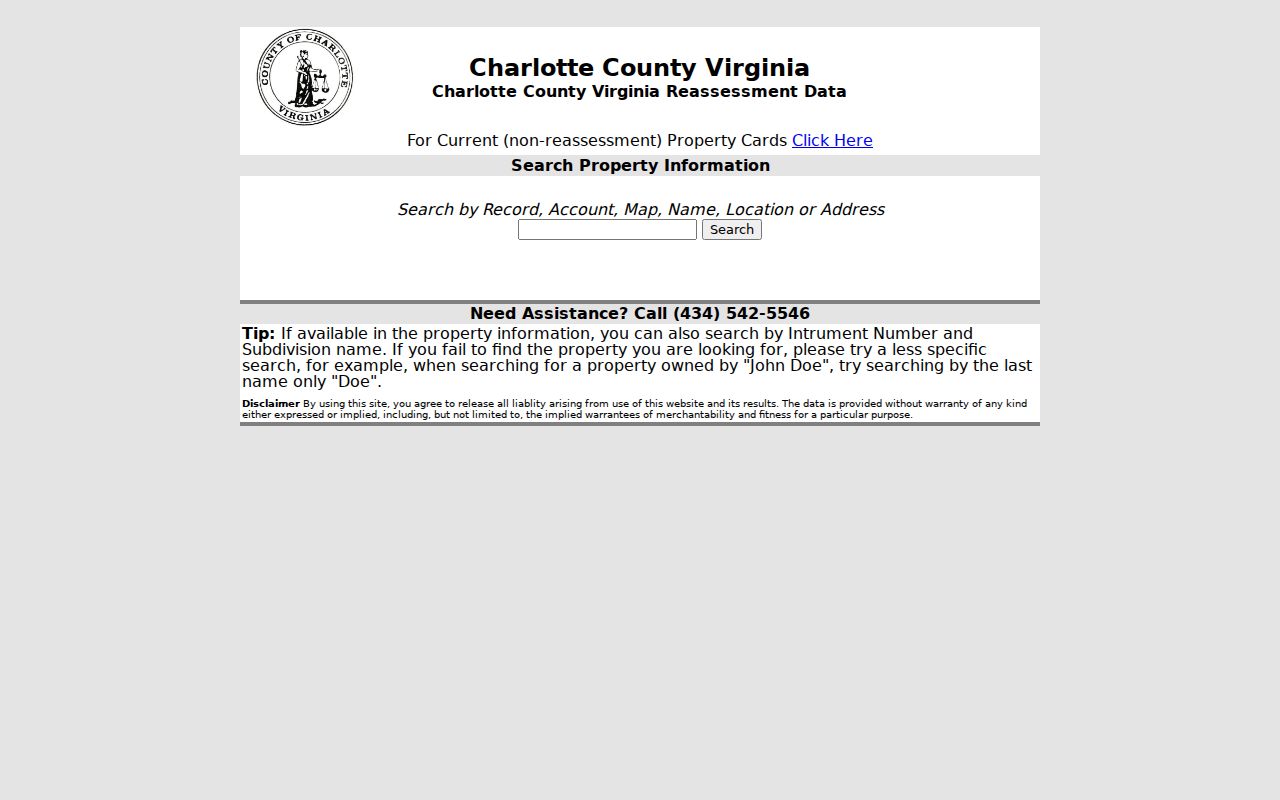
Note: A higher assessment percentage is not the same calculation as the tax bill; value, rate, and the final bill must be read as separate items.
Record Sets Behind a Charlotte County Property Search
Charlotte County property records describe different parts of a parcel's history, so start with the right record family rather than treating every number as proof of ownership. An assessment card locates the parcel and shows the county's administrative value. A deed documents an instrument recorded with the Clerk. A Treasurer entry covers the tax account, and a GIS map gives a spatial reference.
| Record Type | What It Documents | Kept By | Access |
|---|---|---|---|
| Deeds and land instruments | Recorded conveyances, liens, plats, releases, easements | Circuit Court Clerk | SRA where enabled; clerk counter or request |
| Assessment cards | Owner-of-record tax entry, identifiers, valuation data | Commissioner of the Revenue | Current and 2025 card portals |
| Tax bills and balances | Amounts due, payment, due dates | Treasurer | County page and payment portal |
| Tax maps and parcels | Parcel shape and map context | Commissioner and county GIS | Online GIS, office, or focused records request |
| Permits and zoning | Applications, project scope, approvals | Town or county, by location | Responsible office and forms |
Match the record to the question. A transfer calls for the latest deed and its legal description. Value calls for the assessment card. Current charges call for the Treasurer. A plat or GIS outline can help you match a parcel. But only the filed instrument and a surveyor's work answer their own legal questions. The full Charlotte County deed-records route explains the clerk index and instrument families.
A Deed Index Behind Charlotte County Property Records
Every deed recorded in Charlotte County lives with the Circuit Court Clerk. The Clerk serves as custodian for land instruments. Virginia runs a statewide online system for these files. It is called Secure Remote Access, or SRA/COVERS. Access works only when the local clerk has enabled it. Virginia Courts splits the system into two tiers. Index-only searching is free. Opening an actual document image is different. That tier needs clerk authorization, a signed agreement, and payment. The statewide landing page says nothing about Charlotte's local availability, document codes, image coverage, or oldest online year. Call the Clerk before assuming an instrument can be pulled remotely.
At the counter, ask for the public land-record terminal. Or ask for the book and index series holding the instrument. Give the clerk owner names, a recording date, an instrument number, book and page if known, or a legal description. Chain searches take patience. Run both grantor and grantee spellings. Watch for initials, business names, estates, married names, and other variants. The Clerk's office sits at 115 David Bruce Avenue in Charlotte Court House. It is open 8:30 a.m. to 4:30 p.m.
The official Virginia SRA access guidance lays out the difference between index and image access. It is a statewide rule page, not proof that every Charlotte instrument has an online image.
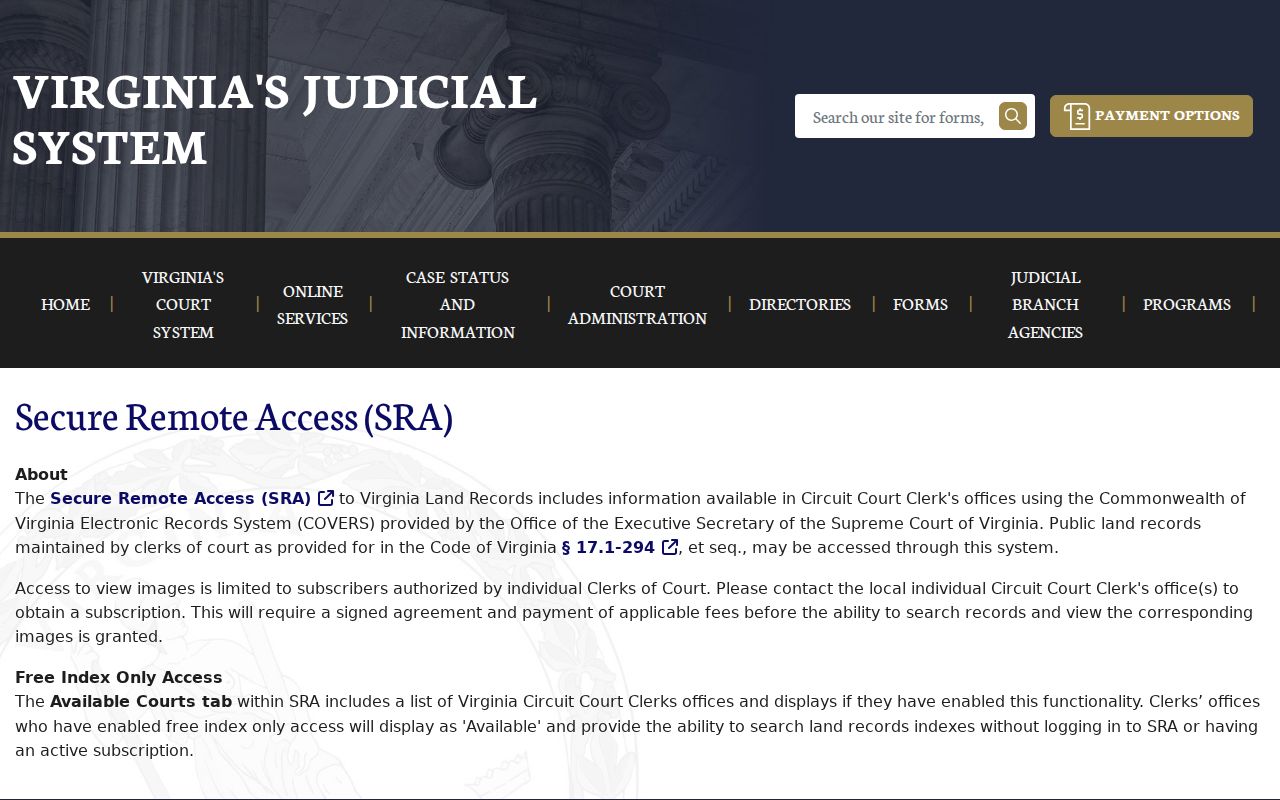
Whenever the online route seems murky, the Charlotte Clerk can confirm the local path and quote the current copy or research charges, which the office sets directly.
GIS and Plat Evidence for Charlotte County Property Records
Charlotte County posts its On-line GIS Tax Maps at charlotte.civ.quest. An alternate parcel viewer is linked as well. A mapped parcel ties an address to a map number. It also shows context. Nearby land, road frontage, streams, and subdivision layout all appear on the layer. Layer lists, popups, select tools, exports, and downloads vary. Trust only the controls visible on the live map.
Charlotte County property records may send you from an assessment card to a map number. That number is neither a deed instrument number nor a tax account. Keep labels exactly as printed. If a map line seems to clash with a fence, deed call, or lot corner, request the recorded plat from the Clerk. Bring in a licensed surveyor. Remember what the map is. It is a tax and planning aid, not a boundary survey, title search, or proof of where an easement sits.
The county's GIS tax-map viewer is the official online starting point. Its launch view is the first screen, not a neighbor-selection tool.
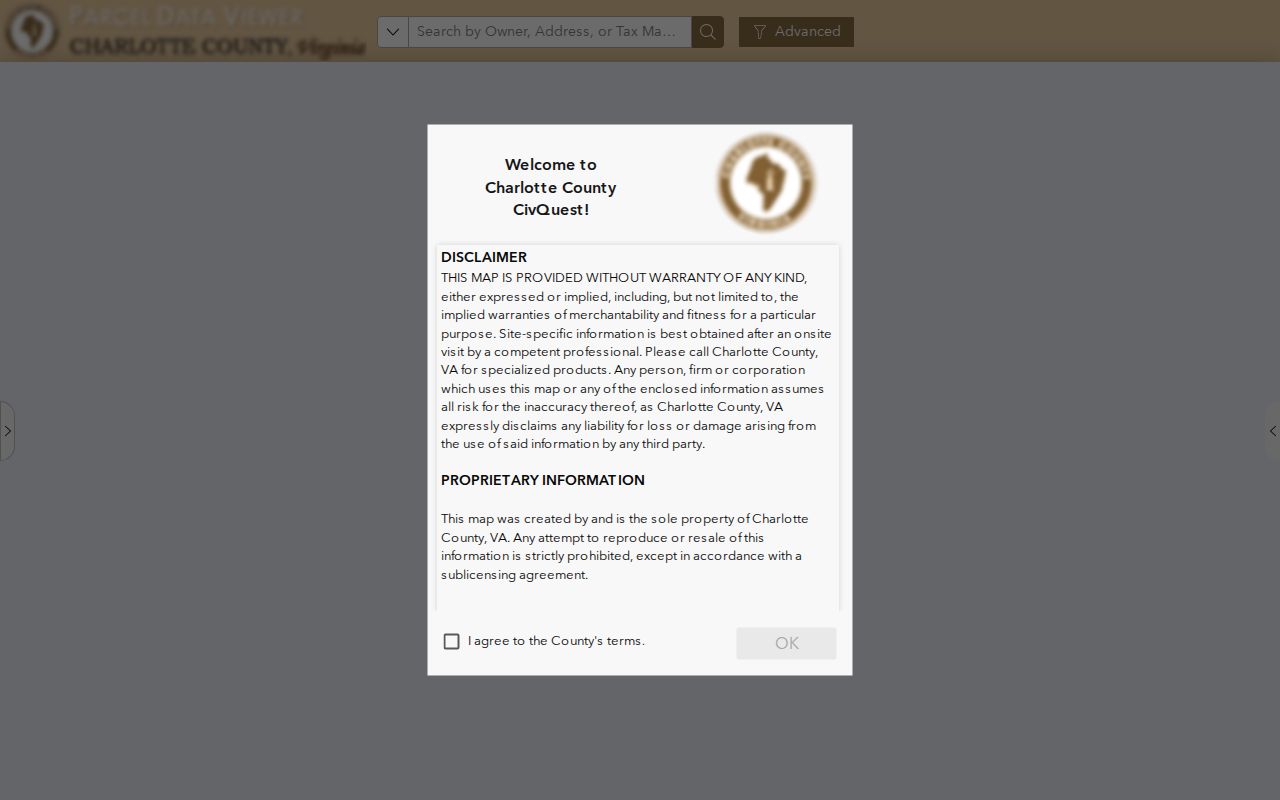
If an online map cannot settle a question, ask the Commissioner for the tax map, or request existing GIS metadata from the county through Virginia FOIA.
Town Zoning and Charlotte County Property Records
Jurisdiction comes first in any permit search. County instructions place property inside Charlotte Court House, Drakes Branch, Keysville, or Phenix under that town's zoning. Land outside those limits follows the county process. A street address or mailing ZIP cannot settle the question. Confirm the town charter boundary or ask the town office. Do this before filing an application or records request.
The official county permits page describes building applications. These may require contractor details, project cost, project size, and plans. For county building questions, it lists Building Official John Hess at (434) 542-5404 and jhess@charlottecountyva.gov. No searchable public town permit database exists online. For a town parcel, ask the town clerk or office for the zoning permit, council action, site plan, or ordinance. Give the address, parcel description, applicant, and approximate date.
Review the Charlotte County permits and zoning instructions for the county process. The page shows county application guidance only; it does not establish each town's search system.
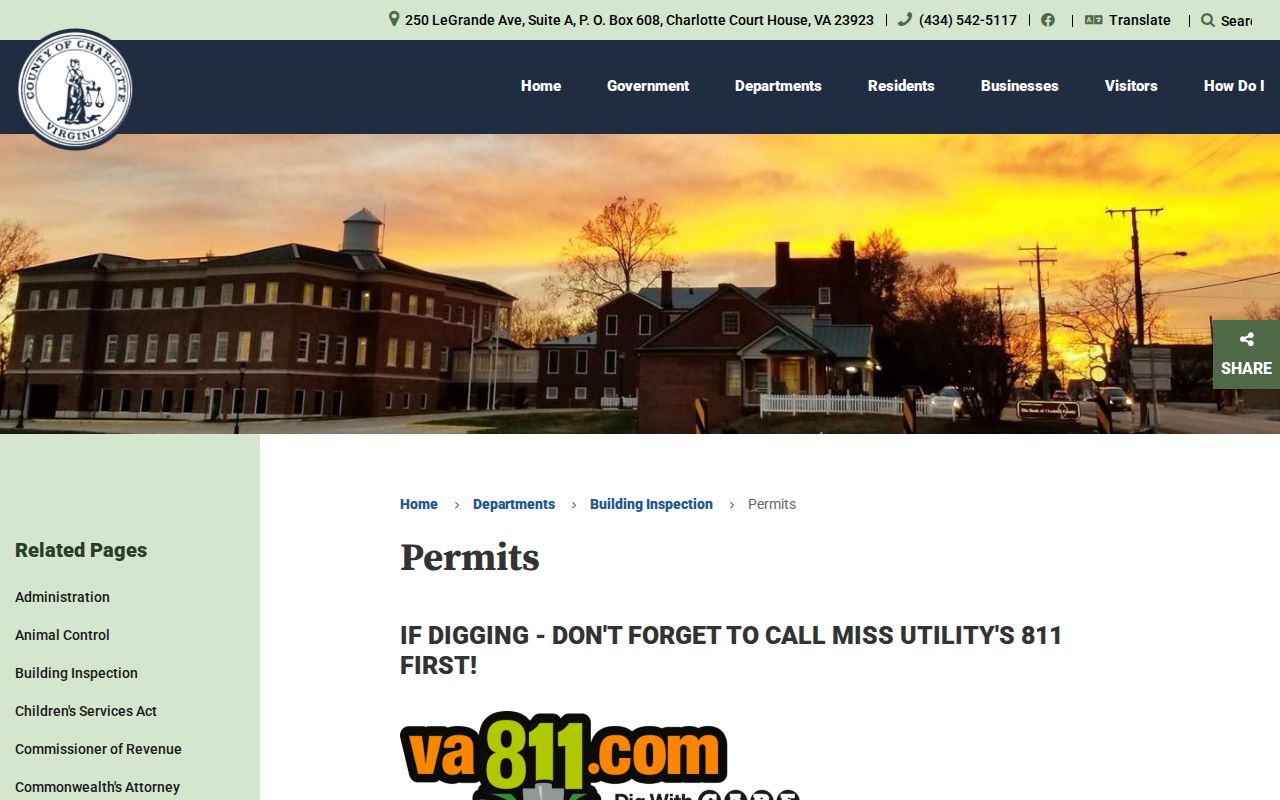
A town permit records a land-use or construction action, not ownership. Confirm the parcel separately in the card and the recorded deed.
County building applications may also require the contractor's name, phone, license number, estimated job cost, project size, and plans. Virginia's Department of Professional and Occupational Regulation runs a license lookup. It helps verify a professional named in a permit or recorded file.
The Virginia DPOR license lookup is the state's official tool. It checks a contractor tied to a project.
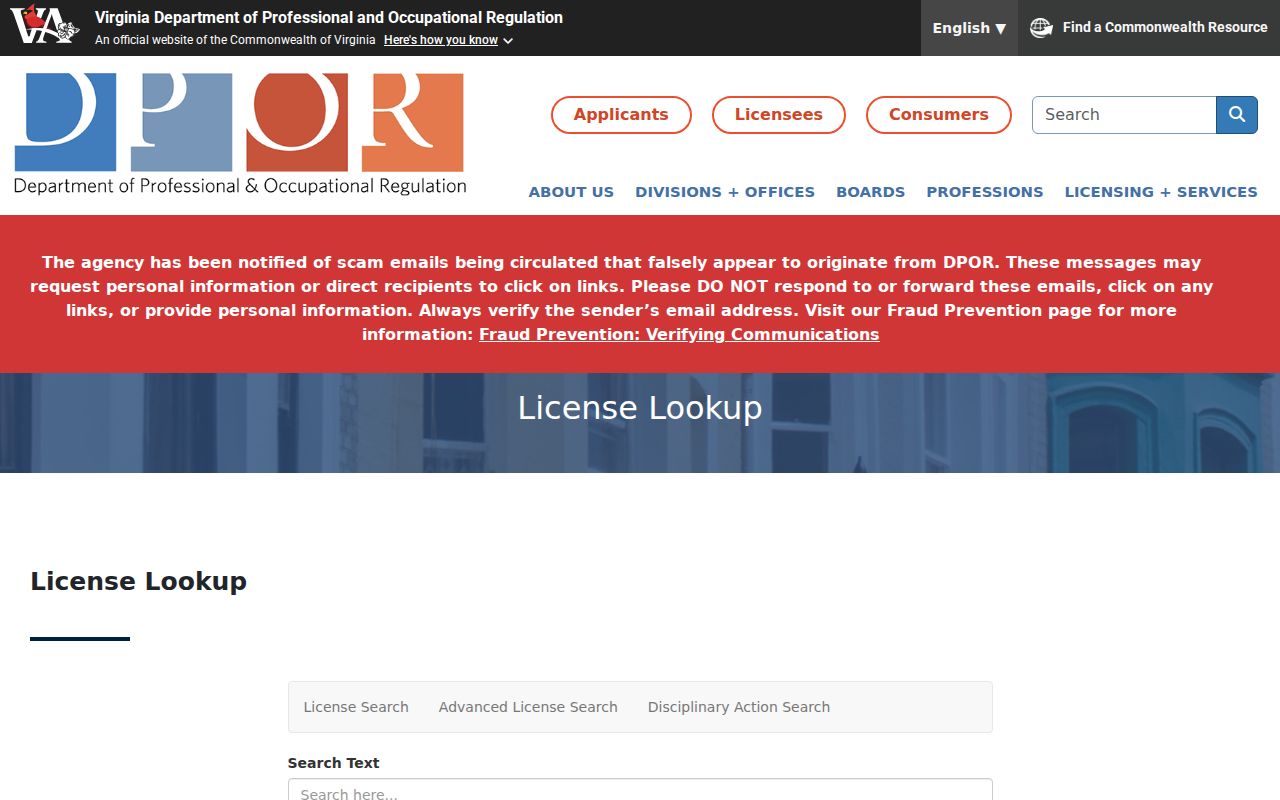
A professional license search never establishes property ownership or replaces a permit record from the responsible town or county office.
Charlotte County Property Records and the Tax Calendar
Assessment and billing sit in two different Charlotte County offices. The Commissioner of the Revenue values each parcel and prepares the tax books. The Treasurer then mails the real-estate tax bill and collects it. Two due dates anchor the calendar. Real-estate taxes are due December 5 and June 5. Miss one, and penalties plus interest begin to run. The county tax page explains the rules. But the Treasurer can quote the exact amount on a late bill today.
The online payment portal handles billing only. It settles a balance. It does not certify ownership, discharge a lien, or stand in for a deed search. The Treasurer keeps office hours Monday through Friday. The hours are 8:30 a.m. to 5 p.m. The phone number is (434) 542-5125. The county tax page also links payment options and exemption programs. Confirm eligibility and current forms with the office. No overview here assigns an exemption to any owner of record.
Need the local rate? Deadlines, penalties, and payment choices? The county's real-estate tax page is the authoritative source. Treat any image of it as a reference for guidance. A parcel's actual tax bill must be checked in the live system.
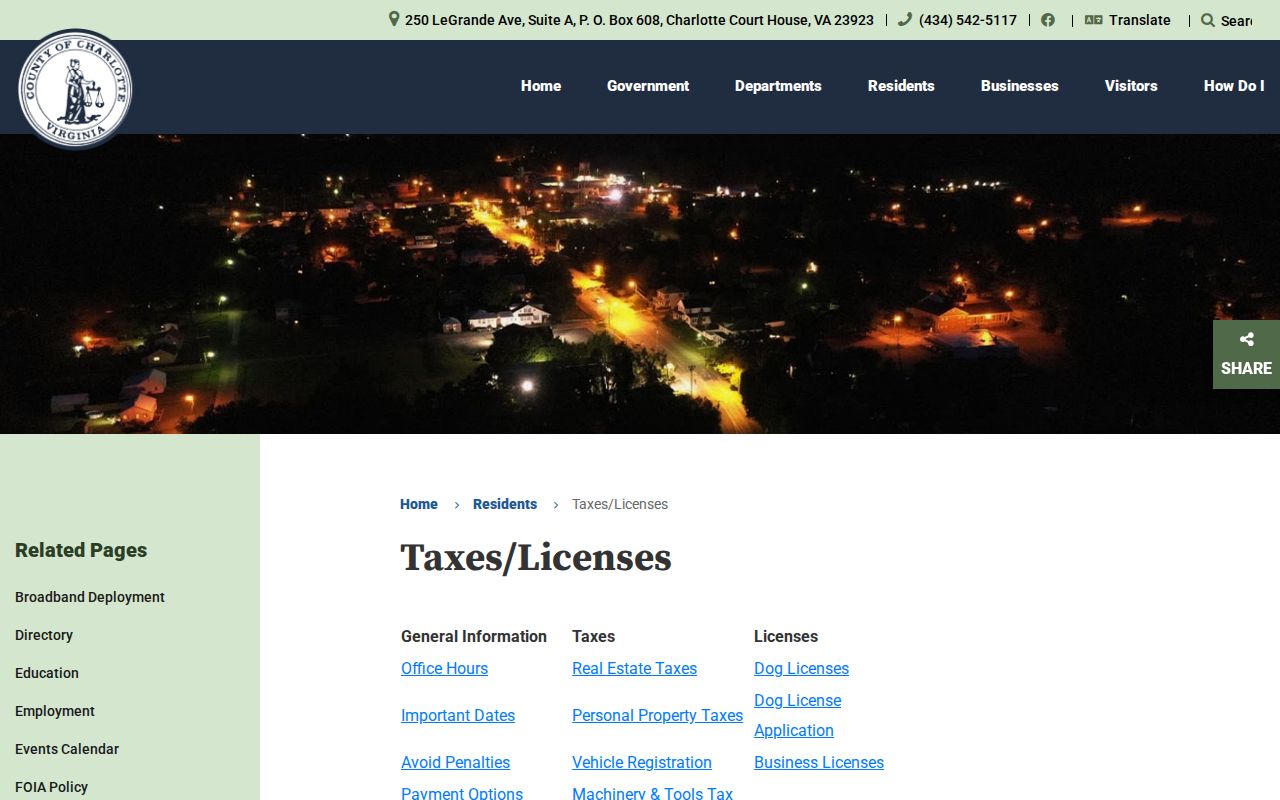
Keep two questions apart when a value looks wrong. The assessed value is one issue. The amount due is another. Appeal the assessment through the county's reassessment instructions rather than arguing the bill.
Virginia FOIA Requests for Charlotte County Property Records
A portal does not hold everything. When a Charlotte County record exists but is not online, Virginia FOIA, Va. Code §§ 2.2-3700 et seq., gives you a route to it. The law covers public records subject to statutory exemptions. Write the request to one office and make it specific. Name the parcel or owner of record. Give the record type and a date range that helps. Ask for an existing permit, map, assessment, or payment document. Staff cannot be asked to draft a title abstract or legal conclusion.
Timing is fixed by statute. Virginia law generally requires an initial response within five working days. A written extension is allowed when the agency needs more time. Charges may cover actual search, duplication, and supply costs. A large request can trigger an estimate or advance payment. Narrowing to one parcel, instrument, or tax year helps the custodian find the file. That keeps the estimate small.
The Virginia FOIA response rule sets out the response timing and cost basis. Read the statute there. Ask the county FOIA officer about the local submission channel. Also ask about any estimate before sending a request.
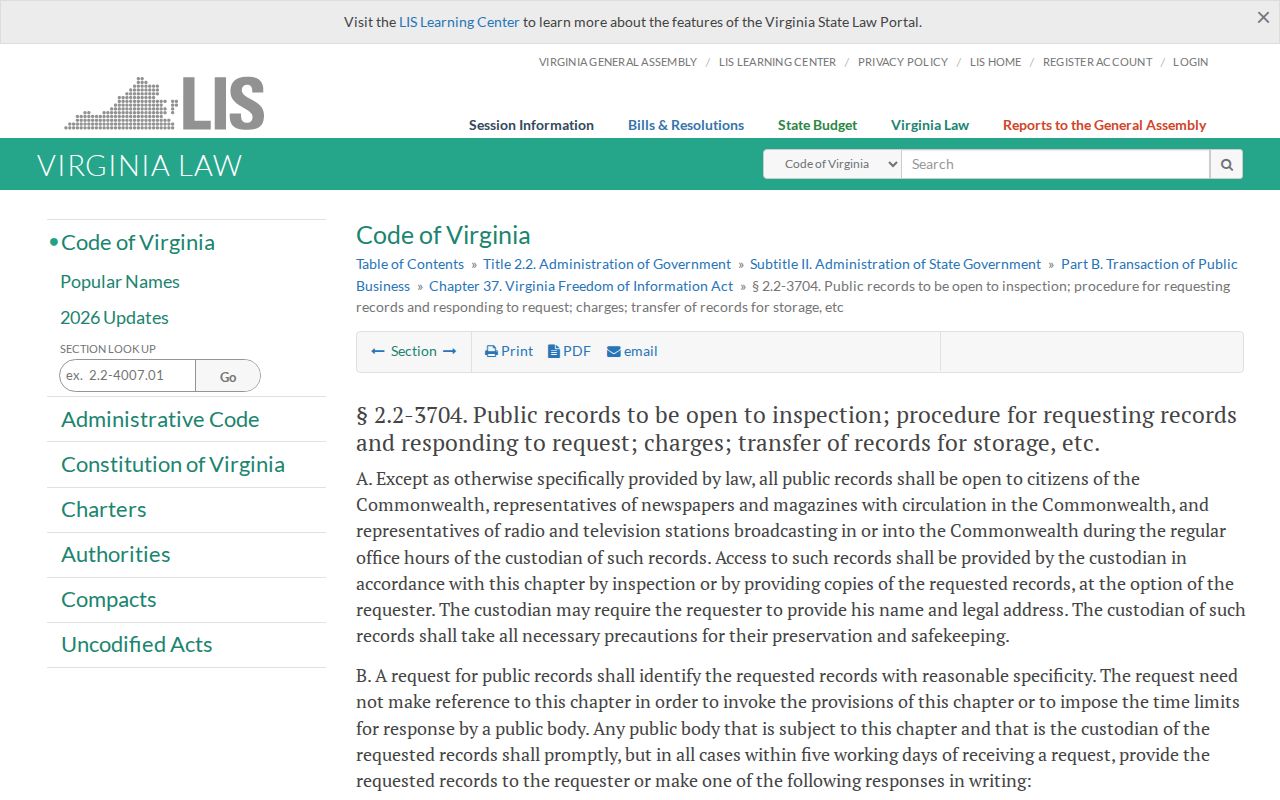
Match the request to the custodian. Ask the Circuit Clerk directly for an instrument copy. Go to the Commissioner first for an assessment or map record.
Historic Names in Charlotte County Property Records
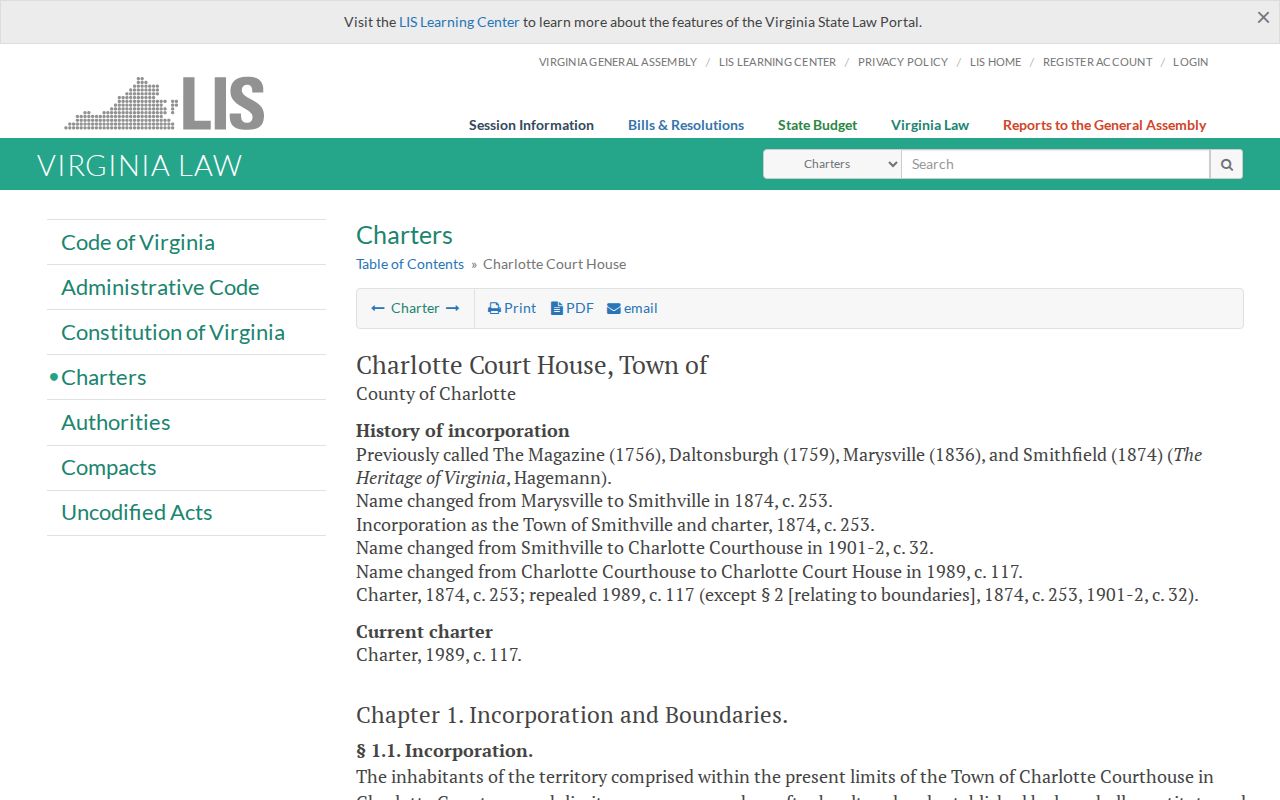
Old records around Charlotte Court House carry names older than the town itself. The Virginia charter history lists several past names. They include The Magazine, Daltonsburgh, Marysville, Smithville or Smithfield, Charlotte Courthouse, and Charlotte Court House. A historic directory, newspaper notice, or plat may use any of these. So test each hit against its date and place. Do that before tying it to a parcel or owner.
Boundaries tell a similar story. The current town line is courthouse-centered and follows the two-mile-square description in the 1874 charter. Keysville's charter points to a boundary plat in Common Law Order Book 18, page 83. Both are record locators, one from a charter and one from a clerk-held order book. Neither changes countywide custody of land deeds and assessments.
The Charlotte Court House charter history preserves the full name sequence. Use its spellings when searching local historical indexes.
The Clerk can point you to the available deed books and indexes. No verified digitization start year exists yet, so confirm earliest holdings with the office.
Address Clues in a Charlotte County Property Search
A rural Charlotte County address rarely matches the wording on a tax card or a historic deed. Try the road name with less punctuation. Drop the route detail. Use the map, account, or record number when a tax notice supplies one. Watch the fields, too. A mailing address marks where mail goes. A situs marks where the land sits. The two differ when the owner of record gets mail elsewhere, uses an agent, or keeps a rural route address.
Local ZIP codes include 23923 for Charlotte Court House, 23947 for Keysville, 23959 for Phenix, and 23976 for Wylliesburg. USPS boundary geometry is not established here, and no Drakes Branch ZIP is confirmed. So never treat a ZIP as proof of a parcel's town or even its side of a jurisdiction line. For that answer, read the charter, check the mapped parcel, and ask the responsible town or county office.
Labels matter. A parcel map number, an assessment account, a record number, a deed instrument number, and a book/page reference are not interchangeable. One portal may accept several as search modes. That convenience does not make them the same thing.
What Charlotte County Property Records Can Establish
Charlotte County property records can establish an assessment entry, a recorded instrument, a tax charge, or a mapped parcel, each under its named custodian. Together they still form no single guarantee. A tax card may lag a recent deed. An index may lack an image. A GIS line may not match a surveyed boundary. When legal rights are the question, read the original deed, its releases and liens, and the recorded plat.
Lawful use. Use public property information for research, purchase diligence, tax review, and civic purposes. Do not use an owner's information to stalk, threaten, impersonate, or harass anyone; consult a title professional or surveyor for a legal conclusion.