
What Charlotte County Property Tax Records Show
Two offices divide the work in Charlotte County. The Commissioner of the Revenue maintains the assessment side and prepares the real-estate tax books, while the Treasurer's office handles bills, payments, and amounts owed. Before anything else, figure out which record answers your question. A value notice is not a bill. A payment receipt is not proof of title. Knowing which Charlotte County property tax records you need saves a call to the wrong office.
| Field | What It Shows | Where |
|---|---|---|
| Assessed value | County value used in the real-estate tax calculation. | Commissioner of the Revenue |
| Reassessment value | Value for the separate cycle effective July 1, 2025. | 2025 reassessment card portal |
| Exemption entry | Any relief shown on the record; confirm local eligibility and application rules. | Commissioner or Treasurer, as applicable |
| Tax amount and payment | Bill, balance, due date, or payment status. | Charlotte County Treasurer |
| Parcel identifiers | Record, account, map, location, or address search keys. | Property-card portal |
Virginia assesses real property at 100% of fair market value under the state framework. Even so, an assessment is a tax value. It is not an appraisal of what a buyer will pay. A recorded sale price stands as a separate fact in a deed or transfer instrument. Exemptions work the same way. Where one applies, it changes the taxable calculation, not the sale price. Keep those value types apart. Compare Charlotte County property tax records with a deed with that distinction in mind.
The July 2025 Charlotte County Property Tax Records Cycle
Charlotte County reassesses real estate every six years, according to the county. The prior values took effect July 1, 2019. The latest general reassessment took effect July 1, 2025. Pearson's Appraisal Services completed the cycle, and assessment notices went out by mail. The county also hosts a distinct online reassessment-card site. That separate site matters when you compare a current property card to the 2025 value. The notice describes typical changes across broad groups. Site-built and modular homes run 50% to 65%, doublewides up to 70%, land 30% to 50%, and commercial or industrial property 10% to 20%. Those are group ranges, not estimates for any one parcel. Open the parcel's own card and notice instead. Compare its characteristics and its land and improvement entries. Ask the Commissioner about any apparent mismatch. The county reassessment page carries the dated notice and the review process, with the current 2025 reassessment information on display.
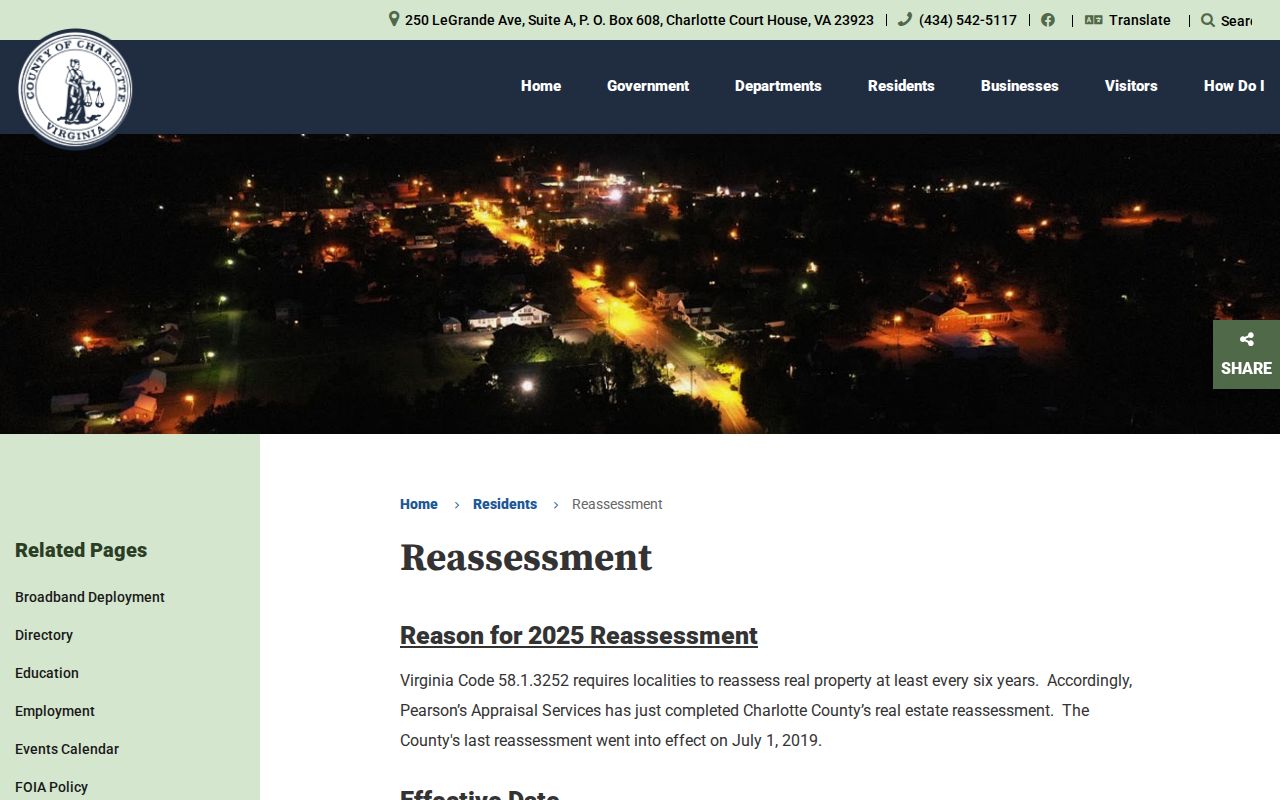
The notice explains the cycle and its general market changes. It does not replace the parcel's own assessment record.
Charlotte County's $0.41 Rate and the Bill Calculation
Alongside the 2025 reassessment, Charlotte County moved the real-estate tax rate. It went from $0.62 to $0.41 per $100 of assessed value. The county set a revenue target. It aimed to collect no more than 1% more real-estate revenue than in the prior year. Assessed value and rate work together in the bill calculation. Neither percentage alone tells a parcel owner how much the bill changed. Read the effective year, assessed value, and tax rate as separate entries. Treat any exemption and the amount due the same way. If a bill looks inconsistent with the card, take the calculation to the Treasurer. Take the assessment to the Commissioner. Do not use the new rate as a stand-in for the parcel's actual bill. One home's value increase says nothing about a countywide revenue result. The county's taxes and licenses page publishes the rate. It also posts the current collection rules, including the county's real-estate tax guidance.
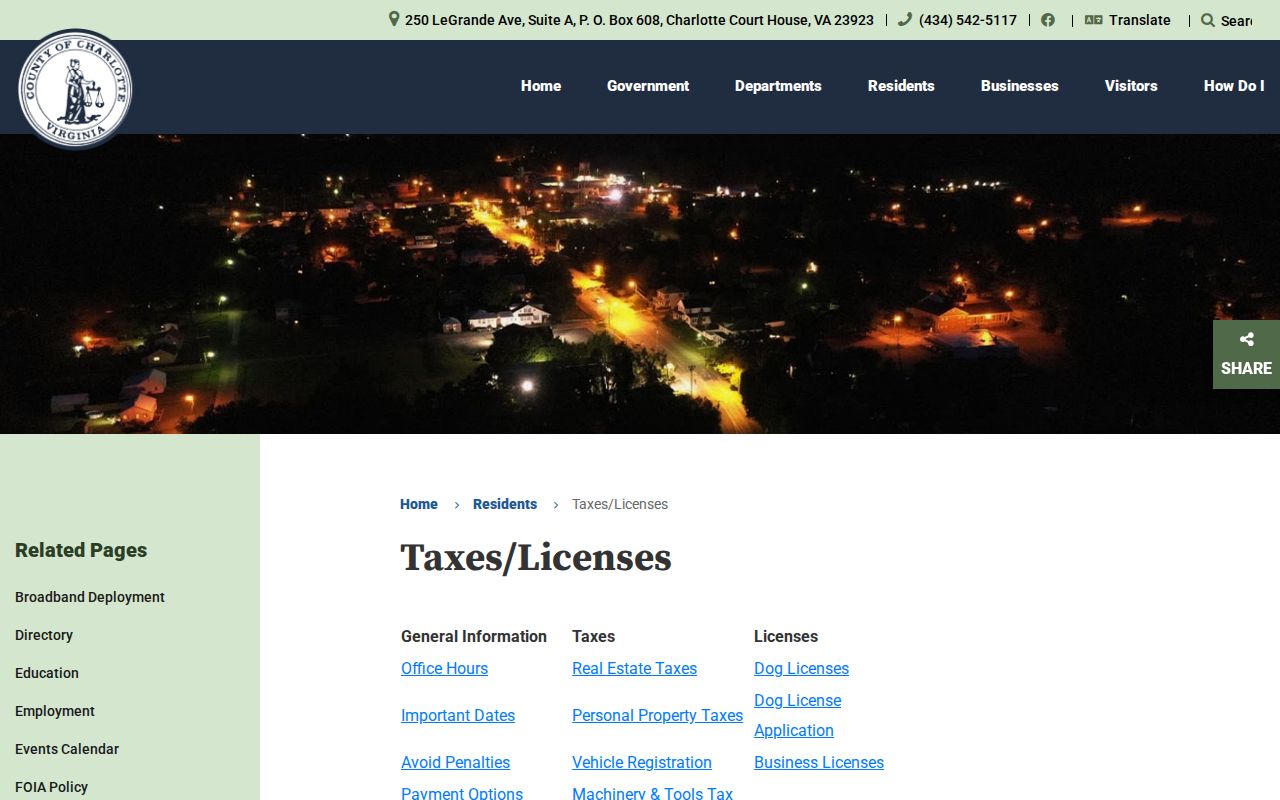
For a specific account, use the live payment portal or call the Treasurer. A general rate example is no substitute for the actual bill.
Current and Reassessment Cards in Charlotte County Property Tax Records
Charlotte County posts current property cards at charlottecountypropertycards.com and runs a separate 2025 reassessment portal. Both offer Record, Account, Map, Name, Location, and Address search modes. The reassessment site adds Instrument Number and Subdivision as optional modes where that data exists. Use the first dataset for the current card view. Use the reassessment site for the new-cycle comparison. Note which source produced each figure. The portals do not spell out every field on a finished card. Do not assume a uniform layout. Check the owner label, land and improvement breakdown, exemptions, and effective date in the live record. For important entries, confirm with the Commissioner of the Revenue. The current card portal and the reassessment search are distinct official destinations. The current-card site displays its query modes on its search page.
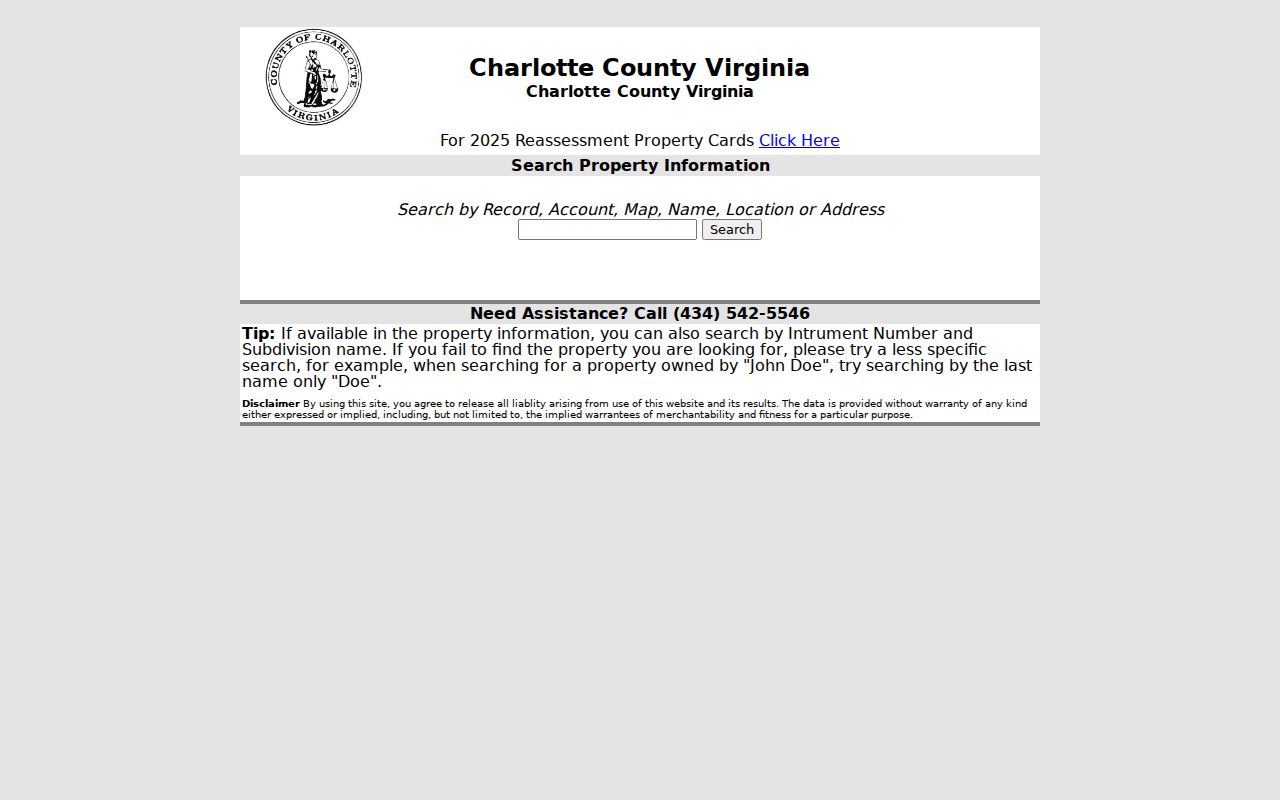
When checking 2025 values, note the reassessment portal's name so it is not confused with the current-card dataset. The 2025 reassessment portal lists its own query options on its search page.
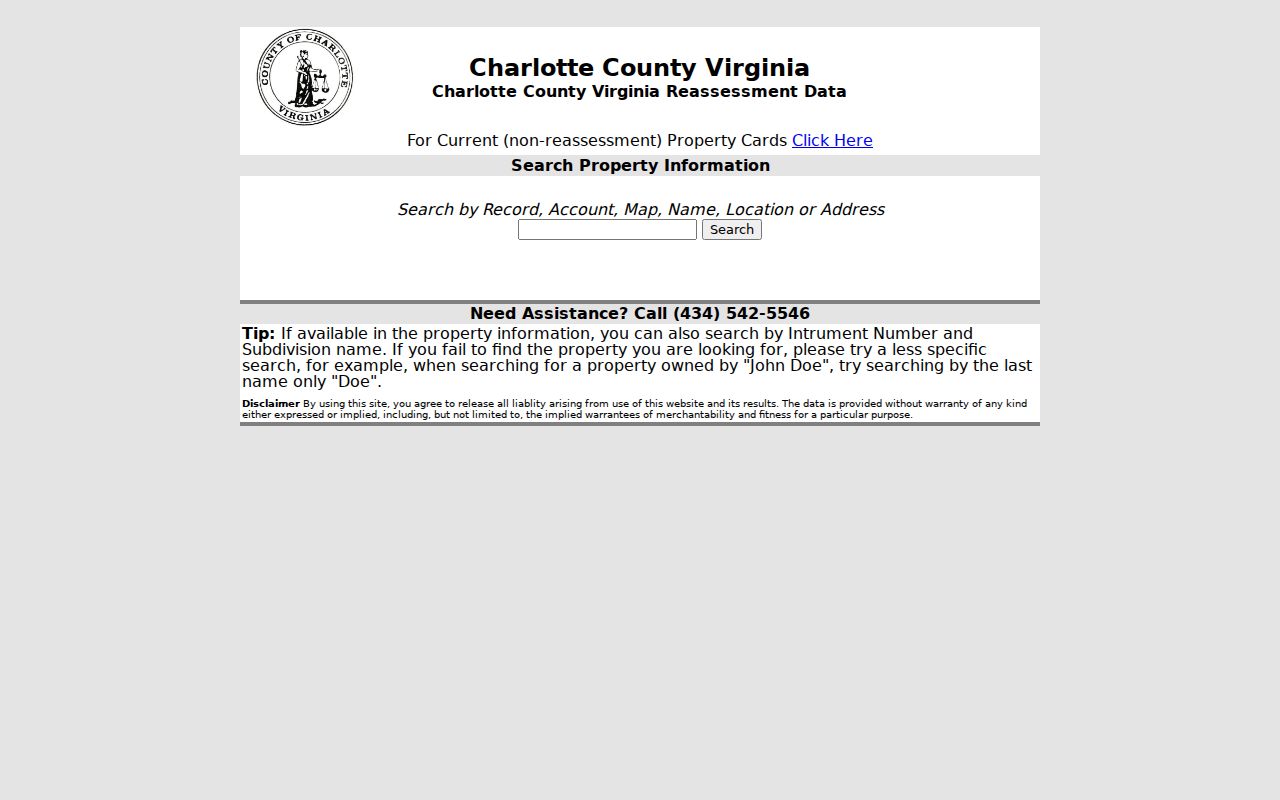
The reassessment site's search page lists query modes, not the fields on an individual tax card.
How to Check a Charlotte County Tax Bill
The Treasurer, not the card site, handles bills, payments, and balances. Start with the address or the account identifier printed on the notice. The county's payment portal covers online account and payment tasks. It does not publish its form fields or convenience charges up front. A search may fail. A charge may be unclear. In either case, use the Treasurer's contact details on the county tax page.
- Locate the parcel in the current or reassessment card if an account number is not known.
- Open the county Treasurer or payment portal and search with the bill's own identifier.
- Compare the current amount, due date, and payment status with the notice you received.
- Ask the Treasurer about penalty, interest, delinquency, and any payment not shown online.
- Assessed value
- The county's value entry used in the real-estate tax calculation.
- Rate
- The dollars charged per $100 of assessed value for the stated tax year.
- Exemption
- A reduction allowed under the applicable program; confirm the current local list and filing requirements.
- Tax lien
- A claim recorded or created under law for unpaid tax; confirm the balance and instrument with the proper office.
December 5 and June 5 Due Dates for Charlotte County Property Tax Records
Two real-estate installments anchor the county's tax calendar. The tax page sets the annual due dates at December 5 and June 5. Check the dates printed for your own tax year, since the calendar can shift. Holidays and posting times can affect when a payment counts. The Treasurer can settle any dispute over an amount due. The office keeps weekday hours of 8:30 a.m. to 5 p.m. It also takes calls at (434) 542-5125. Payments can also go by mail to P.O. Box 267, 201 David Bruce Avenue, Charlotte Court House, VA 23923.
Penalties and interest apply after a due date. But the county page does not state a current percentage or a parcel's payoff figure. Get the exact amount from the Treasurer before working from an old notice. Ask how the office credits a payment once it arrives. The county's secure online payment page may display account-specific details. Convenience charges for card and service payments appear on the live portal. A payment receipt proves one transaction only. It does not prove a deed was recorded or a tax lien was released.
Exemptions and Tax Relief in Charlotte County Records
An exemption can change the taxable math when the owner and the property both qualify. The county publishes exemption information. But no complete local list of programs, thresholds, deadlines, or forms appears there. So do not assume a homestead, senior, or veteran exemption exists. Just because a form mentions one means little. The Commissioner or Treasurer can say which program fits a given parcel. They can also list the proof each application needs.
On a property card, separate the gross assessed value from any exemption or taxable value entry. That split matters. The portal's landing page does not expose every result field. Open the parcel record itself before judging whether an exemption is present or missing. If the card and the bill disagree, take the assessment entry to the Commissioner. Take the billing side to the Treasurer and ask how the entry was applied.
The county's taxes and licenses page is the confirmed route to exemption information. It also holds office contacts. It links the property-card and GIS tools too. It is not a substitute for individual eligibility advice from the record's custodian.
Separate Value Changes from the Charlotte County Tax Bill
Owners who dispute a reassessment can follow the county's Board of Equalization instructions. The county says appeals are heard by appointment. The reassessment page is the place to check the current process. Keep the assessment notice and the parcel card. Also keep any evidence tied to the property's condition or characteristics. No universal appeal deadline applies. Use the date and filing directions on the current county notice rather than an assumed annual calendar.
Keep the appeal aimed at the assessment itself. A factual property characteristic or a valuation issue is fair ground. A question about payment, penalty, or balance belongs with the Treasurer instead. The county states that the 2025 values take effect July 1, 2025. The county also states that the reassessment cycle runs six years. Any appeal request should identify the parcel and the cycle at issue.
Board of Equalization review. Contact the county for the current appointment process and filing deadline. The published notice is the controlling source for dates; do not rely on an older cycle's calendar.
The reassessment page carries the county's current appeal instructions. If a county notice leaves a point unanswered, call the Commissioner before the stated filing date.
A Tax Card Is Not the Charlotte County Tax Bill
The property-card portal and the Treasurer's payment system serve different purposes. The Commissioner maintains assessment and map records. The Treasurer handles the amount billed, along with payment and collection. A card's value cannot show whether a bill was paid. A payment portal cannot prove who owns the land. Use the record whose custodian controls the question at hand.
For a sale, locate the deed in the Clerk's land records. For a parcel shape, treat the GIS map as a reference. Rely on the recorded plat or a surveyor for a boundary determination. For an assessment, pull the card from the correct cycle and contact the appeal office. This division keeps a change in the $0.41 rate from being mistaken for a shift in market value. It also keeps that change separate from payment status.
The county's taxes page links both billing and assessment resources. Still, confirm each underlying record with its own office.
Appealing a Charlotte County Property Tax Assessment
Charlotte County's reassessment instructions allow review through the Board of Equalization. Hearings happen by appointment. Before contacting the county, gather the assessment notice and parcel identifiers. Collect the specific property facts that support the concern too. The question might instead involve a tax amount. It could involve an exemption application or a payment. In that case, start with the office that maintains that part of the account.
Appeal window. The research did not confirm a standing deadline or appeal form field list. Use the date and directions in the current Charlotte County reassessment notice, request an appointment, and verify receipt with the county.